
 EN
EN  SV
SV Before you begin: confirm that AlmRecorder has Settings → MCP. If it is missing, install a version with MCP support.
Let your agent handle the setup
Copy the complete task, paste it into your agent, then append AlmRecorder’s copied configuration. The secret token is included only when you paste it yourself.
Preview the instructions
Configure AlmRecorder as a local MCP server for ChatGPT desktop or Codex on this Mac.

Work carefully and perform the setup for me if you have filesystem and terminal access. If you cannot edit local files, return the exact ready-to-paste file change and tell me where it belongs.

1. First confirm that AlmRecorder shows Settings → MCP, is in its final app location, and is open.
2. Ask me to enable Enable local MCP server, wait for Listening on …, and choose Copy configuration.
3. I will append the copied JSON configuration below this task. Ask me for it if it is missing.
4. Treat ALMRECORDER_MCP_TOKEN like a password. Never repeat it in your response, log it, or put it in Git, a support issue, or a shared project file.
5. Edit the user file ~/.codex/config.toml. Add [mcp_servers.almrecorder] and [mcp_servers.almrecorder.env] without replacing other Codex settings. ChatGPT desktop, Codex CLI, and the Codex IDE extension share this file on the same Codex host.
6. Use the exact command, ALMRECORDER_MCP_SOCKET, and ALMRECORDER_MCP_TOKEN copied from AlmRecorder. The transport is local stdio and AlmRecorderMCPBridge takes no arguments.
7. Do not alter or delete any other client settings. Show a diff or describe exactly what changed.
8. Restart the surface in use: Restart under Settings → MCP servers in ChatGPT desktop, Restart extension in the IDE, or begin a new Codex CLI session.
9. Ask the agent to call get_library_status and report the recording count. Then call list_recordings with limit: 1. Do not change anything.
10. Do not enable AlmRecorder’s content or write permissions. I will choose those myself after the read-only check succeeds.

ALMRECORDER COPIED CONFIGURATION:
[Paste Copy configuration from AlmRecorder here]
Prepare AlmRecorder
- Keep AlmRecorder.app in Applications and leave it open.
- Open every sensitive recording and turn off Allow MCP clients to access this recording. In Settings → Tags, use Hide from MCP for private categories.
- In Settings → MCP, leave both Allow content, notes, comments, summaries, and transcript search and Allow tags, notes, and comments to be changed off. Turn on Enable local MCP server and wait for Listening on ….
- Choose Copy configuration. You will map its command, socket, and token into Codex TOML.
The token is copied—not revealed
AlmRecorder intentionally masks the real token in the on-screen preview. There is no visible token field to hunt for.
- Open Settings → MCP in AlmRecorder.
- Turn on Enable local MCP server and wait until Status says Listening on ….
- Choose Copy configuration. The clipboard now contains the command, socket, and real ALMRECORDER_MCP_TOKEN.
Paste the configuration directly where this guide tells you. Treat it like a password and clear the clipboard after the connection works.
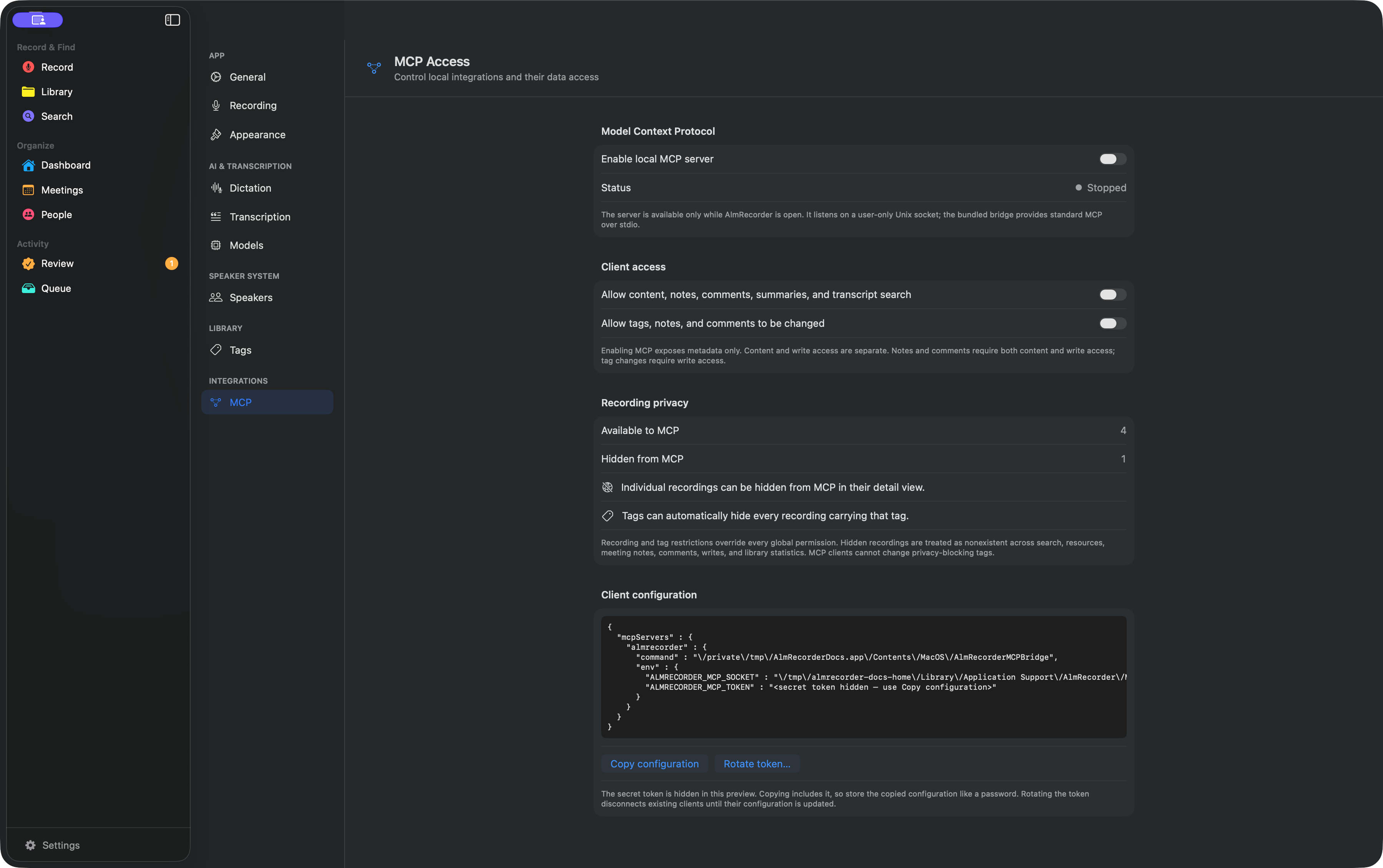 Choose Copy configuration
Permission boundary: the content grant unlocks transcripts, search, summaries, notes, and comments. The changes grant unlocks tag changes. Notes and comments require both. Start with neither.
Add it to OpenAI’s local clients
What is the relationship? Codex is OpenAI’s coding agent. The ChatGPT desktop app now hosts both ChatGPT and Codex experiences. The desktop app, Codex CLI, and Codex IDE extension share one MCP configuration on the same Codex host; ChatGPT web does not read this local file.
Because AlmRecorder needs two environment variables, the dependable setup path is the shared TOML file; the graphical MCP servers screen remains useful for starting, stopping, and inspecting it.
Open ~/.codex/config.toml. Append the following tables—do not replace your existing Codex settings or other mcp_servers entries.
[mcp_servers.almrecorder]
command = "/Applications/AlmRecorder.app/Contents/MacOS/AlmRecorderMCPBridge"

[mcp_servers.almrecorder.env]
ALMRECORDER_MCP_SOCKET = "/Users/you/Library/Application Support/AlmRecorder/MCP/mcp.sock"
ALMRECORDER_MCP_TOKEN = "paste the token copied from AlmRecorder"
Use the exact three values from AlmRecorder’s copied JSON. Keep the TOML quotes. If you installed the app elsewhere, use the copied command instead of the /Applications example.
The token is stored as plain text in this file. Treat ~/.codex/config.toml as private and never paste it into a repository, support issue, or chat.
Save the file. Then restart the client you use:
- ChatGPT desktop: open Settings → MCP servers, confirm
almrecorder, then choose Restart. - Codex IDE extension: open the gear menu, choose MCP servers, and restart the extension.
- Codex CLI: begin a new session;
codex mcp listshould showalmrecorder.
In the desktop composer or TUI, /mcp shows configured servers. This confirms the configuration was found; the next step checks the connection to the open app.
Check the connection
Ask Codex:
Use AlmRecorder’s
get_library_statustool and report the recording count. Then calllist_recordingswithlimit: 1. Do not change anything.
A successful get_library_status confirms that the bridge can reach your open AlmRecorder library. Only then enable the content switch for transcript questions or the changes switch for approved writes.
If it fails
- Tools appear but the call fails: AlmRecorder is closed, the server is off, or the token/socket is stale.
- Bridge not found: move AlmRecorder back to the location used in
command, or copy fresh values after moving it. - Configuration error: confirm the section is
mcp_serverswith an underscore and that both environment values sit under[mcp_servers.almrecorder.env]. - Unauthorized: rotate only if needed, then copy the new token into every configured client.
To disconnect OpenAI’s local clients, remove the two almrecorder tables and restart the surface you use. To stop every client immediately, disable MCP in AlmRecorder.
Codex MCP documentation · Privacy in AlmRecorder · General troubleshooting