
 EN
EN  SV
SV Before you begin: confirm that AlmRecorder has Settings → MCP. If it is missing, install a version with MCP support.
Let your agent handle the setup
Copy the complete task, paste it into your agent, then append AlmRecorder’s copied configuration. The secret token is included only when you paste it yourself.
Preview the instructions
Configure AlmRecorder as a local MCP server for GitHub Copilot CLI on this Mac.

Work carefully and perform the setup for me if you have filesystem and terminal access. If you cannot edit local files, return the exact ready-to-paste file change and tell me where it belongs.

1. First confirm that AlmRecorder shows Settings → MCP, is in its final app location, and is open.
2. Ask me to enable Enable local MCP server, wait for Listening on …, and choose Copy configuration.
3. I will append the copied JSON configuration below this task. Ask me for it if it is missing.
4. Treat ALMRECORDER_MCP_TOKEN like a password. Never repeat it in your response, log it, or put it in Git, a support issue, or a shared project file.
5. Merge almrecorder under mcpServers in ~/.copilot/mcp-config.json with type local, command, an empty args array, both env values, and tools: ["*"]. VS Code uses a different servers format, and GitHub’s cloud agent cannot reach this local Mac socket.
6. Use the exact command, ALMRECORDER_MCP_SOCKET, and ALMRECORDER_MCP_TOKEN copied from AlmRecorder. The transport is local stdio and AlmRecorderMCPBridge takes no arguments.
7. Do not alter or delete any other client settings. Show a diff or describe exactly what changed.
8. Run copilot mcp list, then start a local Copilot CLI session.
9. Ask the agent to call get_library_status and report the recording count. Then call list_recordings with limit: 1. Do not change anything.
10. Do not enable AlmRecorder’s content or write permissions. I will choose those myself after the read-only check succeeds.

ALMRECORDER COPIED CONFIGURATION:
[Paste Copy configuration from AlmRecorder here]
Choose the Copilot that runs on this Mac
AlmRecorder is a local stdio server backed by a Unix socket on this Mac. That creates a firm compatibility boundary:
- GitHub Copilot CLI: supported when the CLI and AlmRecorder run on the same Mac. Follow this page.
- GitHub Copilot Chat in VS Code: supported through VS Code’s user-profile
mcp.json. Use the VS Code guide. - Copilot coding agent on GitHub.com: not supported. The cloud agent runs on GitHub infrastructure and cannot reach AlmRecorder’s local socket or launch the bridge inside your Mac app.
The Copilot CLI and VS Code do not read the same MCP file. Copilot CLI uses ~/.copilot/mcp-config.json; VS Code uses its own servers-format mcp.json.
Install and prepare
Install GitHub Copilot CLI with Homebrew:
brew install copilot-cli
Or use npm with Node.js 22 or later:
npm install -g @github/copilot
Run copilot, enter /login, and complete GitHub authentication. If Copilot comes through an organization, its administrator must allow Copilot CLI.
Then prepare AlmRecorder:
- Keep AlmRecorder.app in Applications and leave it open.
- Turn off Allow MCP clients to access this recording on anything sensitive. Use Hide from MCP for private tags.
- In Settings → MCP, leave the content and changes permissions off. Enable the local server and wait for Listening on ….
- Choose Copy configuration.
The token is copied—not revealed
AlmRecorder intentionally masks the real token in the on-screen preview. There is no visible token field to hunt for.
- Open Settings → MCP in AlmRecorder.
- Turn on Enable local MCP server and wait until Status says Listening on ….
- Choose Copy configuration. The clipboard now contains the command, socket, and real ALMRECORDER_MCP_TOKEN.
Paste the configuration directly where this guide tells you. Treat it like a password and clear the clipboard after the connection works.
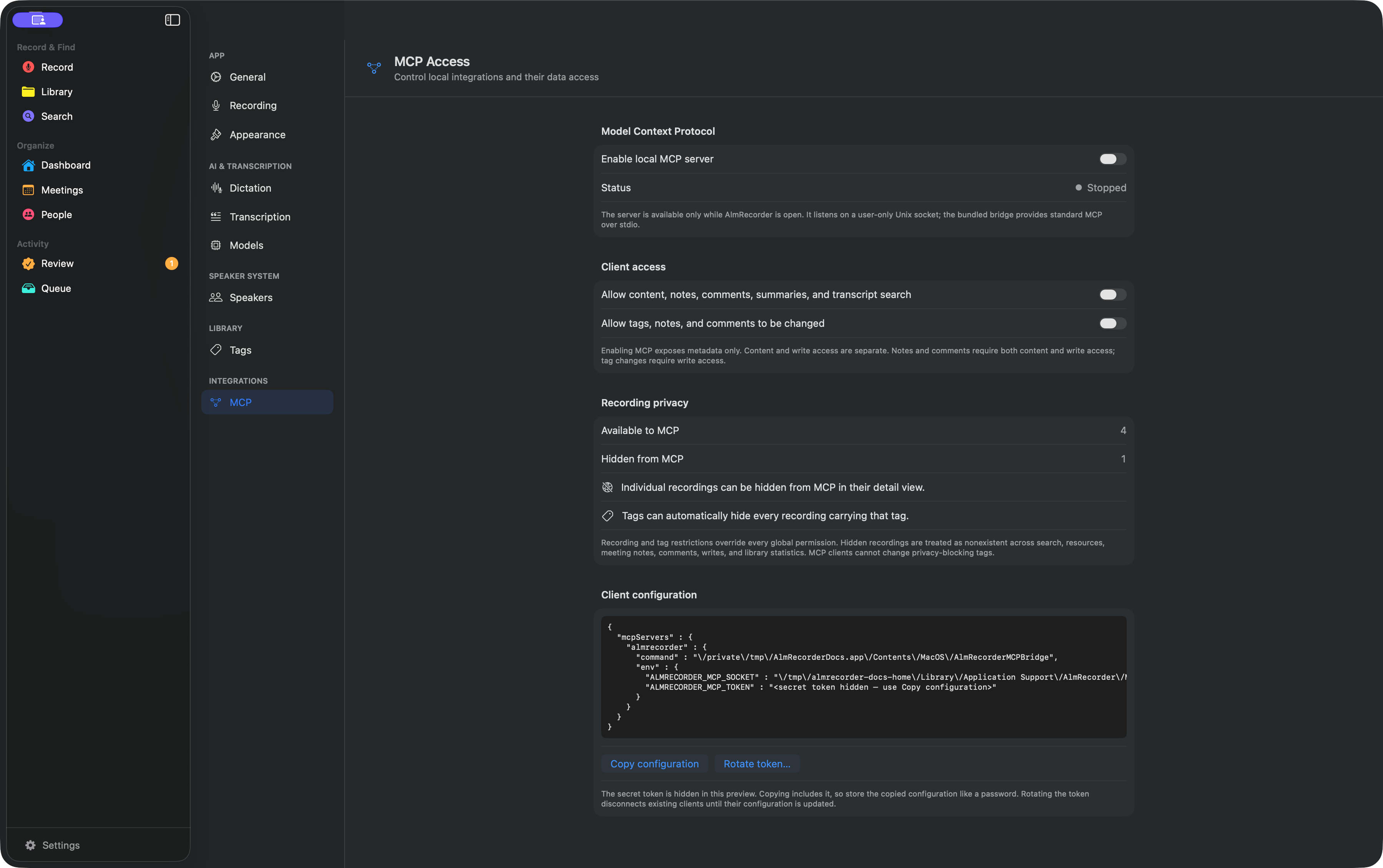 Choose Copy configuration
Permission boundary: AlmRecorder decides which recordings and fields exist for every client. Copilot’s own tool controls add another layer, but they cannot override a denial in AlmRecorder.
Add it to Copilot CLI
Open or create ~/.copilot/mcp-config.json. Merge the almrecorder entry below—do not replace existing servers:
{
  "mcpServers": {
    "almrecorder": {
      "type": "local",
      "command": "/Applications/AlmRecorder.app/Contents/MacOS/AlmRecorderMCPBridge",
      "args": [],
      "env": {
        "ALMRECORDER_MCP_SOCKET": "/Users/you/Library/Application Support/AlmRecorder/MCP/mcp.sock",
        "ALMRECORDER_MCP_TOKEN": "paste the token copied from AlmRecorder"
      },
      "tools": ["*"]
    }
  }
}
Use the exact command, socket, and token from Copy configuration. The token is plain text in this private user file. Do not put it in .mcp.json, .github/mcp.json, Git, a support issue, or a shared prompt.
Check registration:
copilot mcp list
copilot mcp get almrecorder
Inside a local Copilot CLI session, /mcp show almrecorder displays its status and tools.
Check the connection
Ask Copilot:
Use AlmRecorder’s
get_library_statustool and report the recording count. Then calllist_recordingswithlimit: 1. Do not change anything.
The first call confirms that Copilot reached the open AlmRecorder app. Only then enable transcript content or changes in AlmRecorder if you need them.
If it fails
copilotis missing: install the CLI, then sign in with/login.- Server is absent: validate
~/.copilot/mcp-config.json; Copilot CLI does not read.vscode/mcp.json. - Server is blocked: an organization MCP allowlist or Copilot CLI policy may require administrator approval.
- Tools appear but calls fail: keep AlmRecorder open, enable its server, and copy fresh socket/token values.
- It works in VS Code but not CLI: configure both separately; their MCP schemas and files differ.
Run copilot mcp remove almrecorder to disconnect Copilot CLI. Disable the server or rotate AlmRecorder’s token to revoke every copied client configuration.
Install GitHub Copilot CLI · GitHub’s Copilot CLI MCP guide · Privacy in AlmRecorder